Cultural
Integration and Architectural Fusion
as a Strategy for Survival:
the Iconographic Use of Disk
Frieze Ornament
in Pre-Columbian and Early Colonial Buildings
A
Paper Presented To the Conference
Cultural Transmission and
Transformation In The
Ibero-American World, 1200-1800
October 21-22, 1995
Donaldson Brown Hotel and Conference Center
Virginia Polytechnic Institute and State University
James B. Kiracofe
©1995
Inter-American Institute
for
Advanced Studies in Cultural History
Slides
1 & 2
left:
Casa de la Cacica close up
right:
Casa de la Cacica, Long view showing alignment
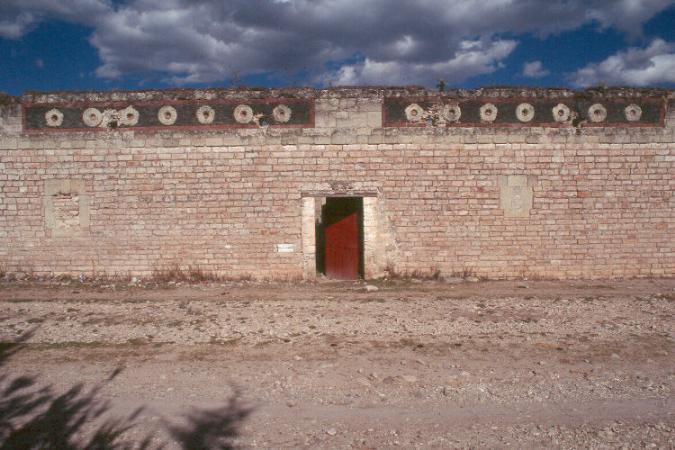
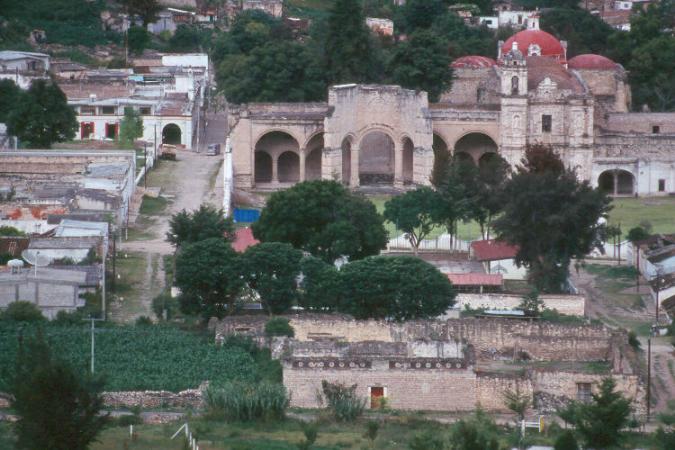
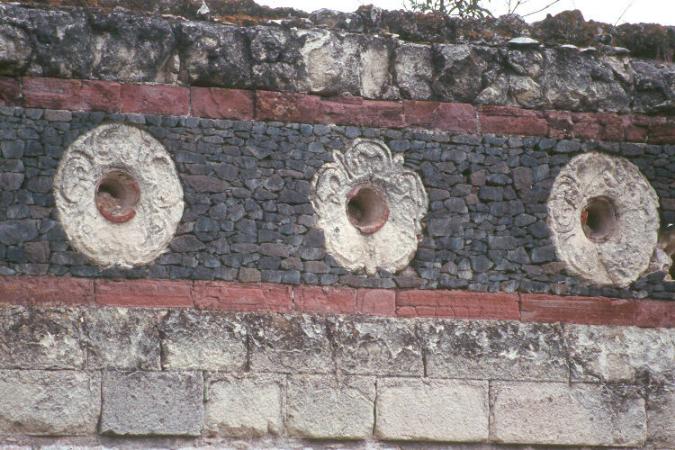
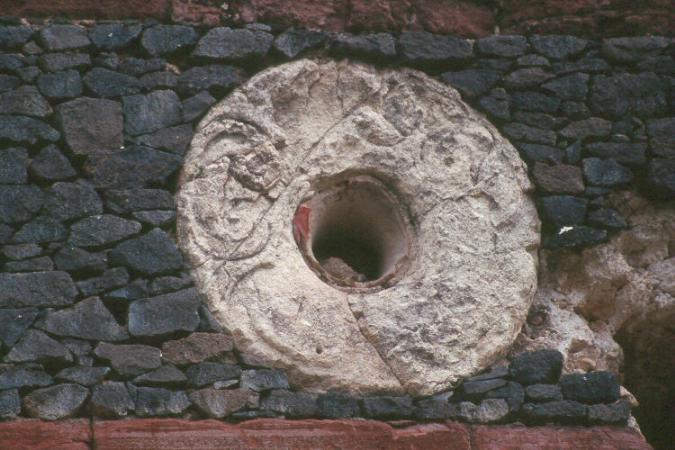
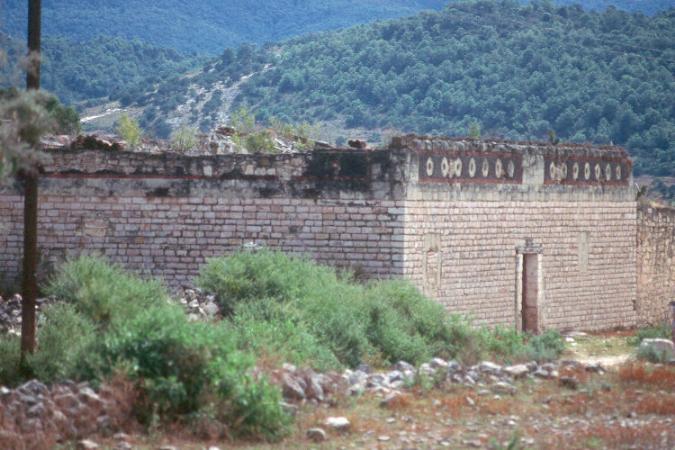
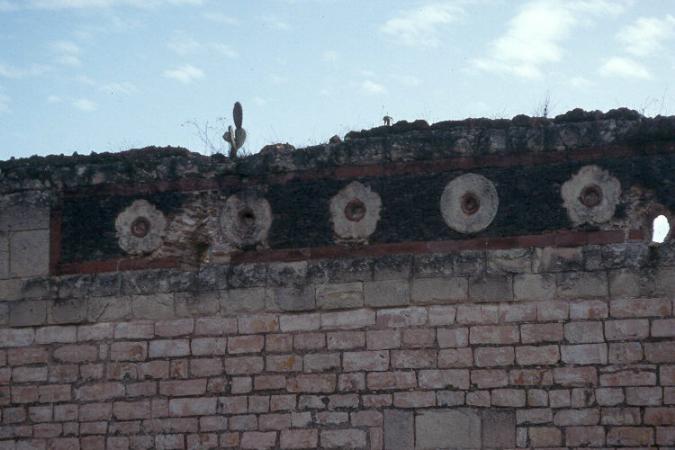
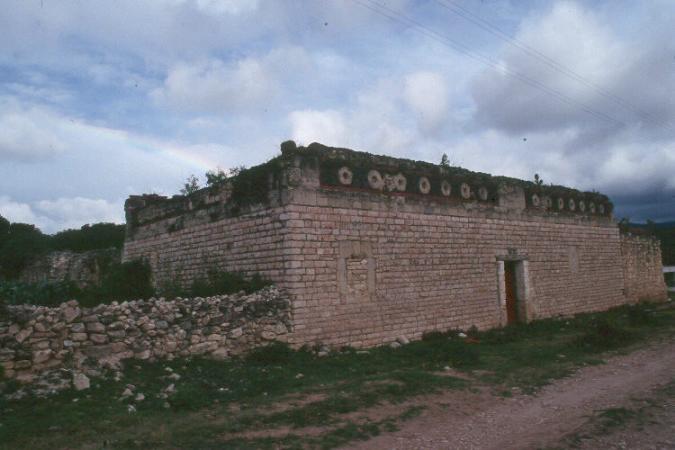
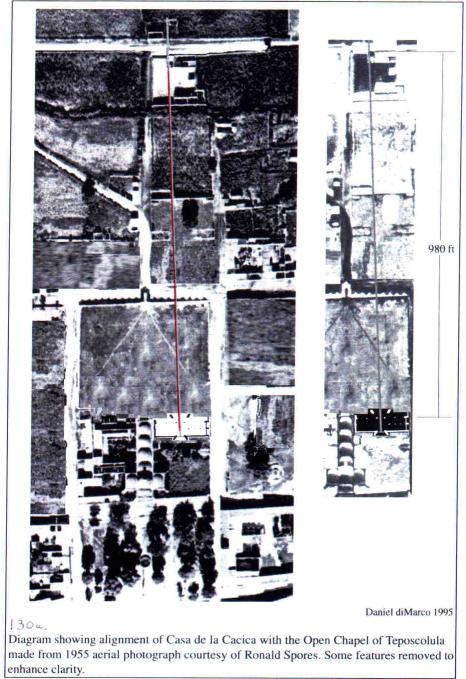
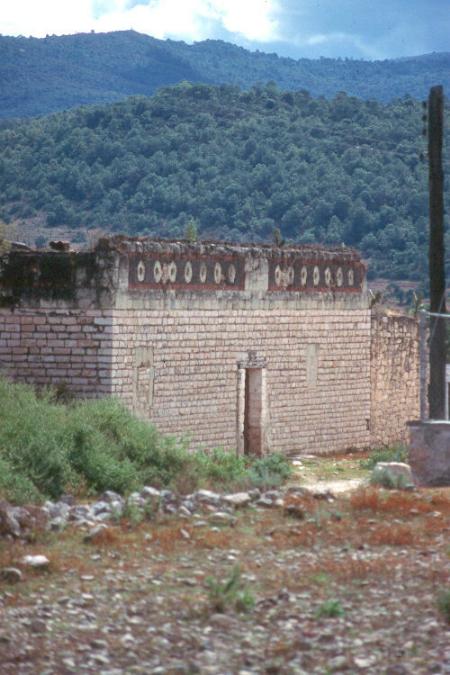
The building you see on the left is the Casa de la Cacica in Teposcolula, Oaxaca, Mexico, built circa 1563 concurrently with the construction of the famous Capilla de los Indios, or Open Chapel seen in the background of the photo on the right. The carefully planned and executed axial alignment of these two structures is a theme I have discussed elsewhere.[i] This morning I wish to draw your attention to the frieze of discs along the top of the Casa de la Cacica.
Slides
3 & 4
Left
Close-up of disc frieze
Right
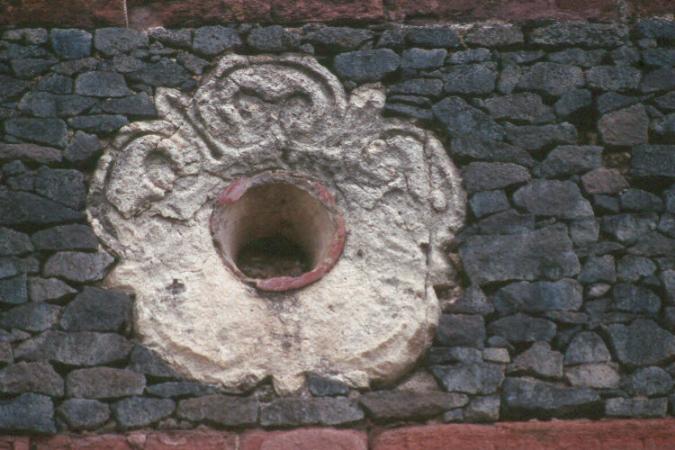
Detail, one disk
A distinctive pre-Columbian architectural feature marked this early
colonial era building as the residence of the local ruling couple and the
location of special ceremonial and administrative activities. It is the disk
frieze that enables us to "read" the building, to pick it out in the
landscape, or urban-scape, as a
special structure. In what follows we will briefly examine a series of other
such "disk frieze" buildings constructed over a long duration
demonstrating the persistence of this highly visible, consistently recognizable
architectural feature used as a ledger for ideological transmission.
We will also see that over time the replication of the disc frieze was by
no means identical, rather there was variation, drift, and transformation.
Nevertheless, we will clearly see that within general parameters the deliberate
and highly restricted use of the disk frieze to call attention to the special
status of particular buildings was a calculated practice used in the
Mesoamerican urban context during at least seven hundred years preceding the
arrival of Europeans.
A particular point I wish to make here is that its use did not stop at
the "conquest" threshold, but rather, indigenous cultural leaders and
designers continued to use this distinctively Mesoamerican architectural feature
as a means of advancing and transmitting their own cultural agenda for two
generations after contact with European culture. Indeed, indigenous leaders
creatively integrated this important architectural element into new kinds of
buildings in which they selectively combined and fused elements of the new
European building technology, architecture and ornament with their own rich
architecturally expressed cultural heritage, including the distinctive disc
frieze.
Moreover, the indigenous leaders were not alone in marking their buildings with the disk frieze. The European friars themselves deliberately employed the disk frieze as a transmitter of meaning, but transformed it into a ledger of Christian ideology. Clearly then, the disc frieze was consciously utilized by Mesoamericans and Europeans alike as a visible sign of cultural integration in the new formal environment they built together in mid-sixteenth-century Mexico. European conquest did not stop the use of this important cultural transmitter and the process it reflected. Unfortunately, European contagion in the catastrophic epidemic of 1576-79 did. Let us turn now to some other examples.
Slides
5 & 6
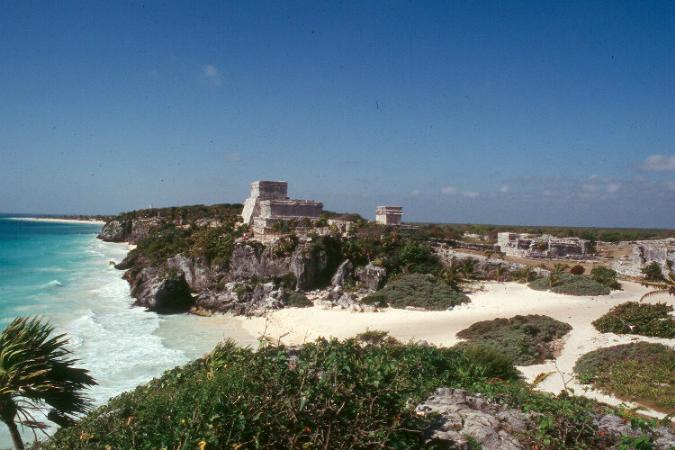
Tulum
general view acropolis
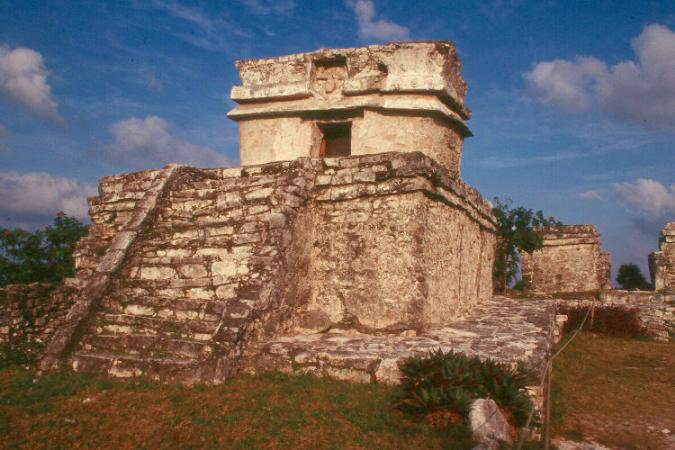
Tulum
Temple of Diving Gods, general view
At Tulum, the spectacular Late Post Classic center perched on the cliffs overlooking the Caribbean Sea on the coast of Quintana Roo, Mexico, there is a disk frieze building on the acropolis. The so-called "Temple of the Diving God," a deity associated with rain or lightening, has also been associated with the Bee God.[ii] Before Spanish contact, Tulum was a center of honey production, an important export commodity in the thriving water borne trading network that linked Tulum with points all along the Yucatan coast as well as many locations deep in the interior.[iii]
Slides
7 & 8
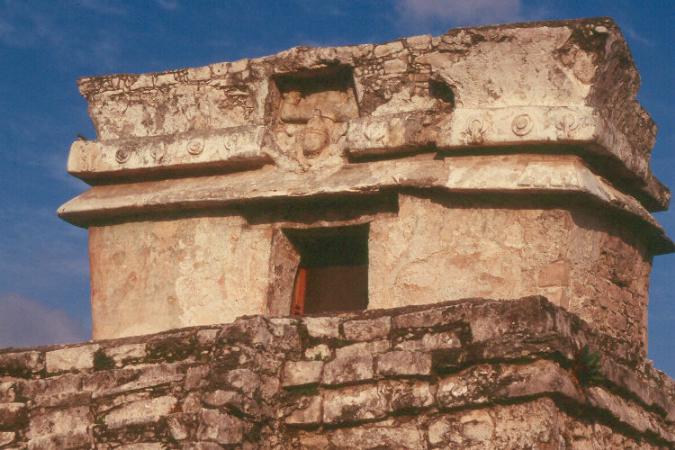
Tulum
Temple of Diving Gods, close up discs
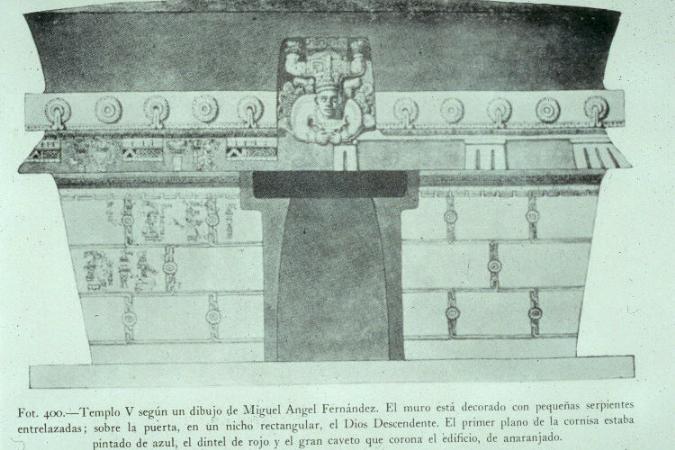
Marquina
diagram
An image of the deity is presented on the principal facade, flanked by horizontal bands clearly displaying disks. The disks are of two types: one a simple round rosette or representation of a flower with a deep hollow in the center, in the way of a 'trumpet" shaped flower, the other similar in every respect except that it appears that their stamens project out, as if hanging out of and downward from the center of the flower.[iv] Because the flower's stamen was the locus of the activity of the fertilizing bees, it is not surprising to find this iconographic complex featured here on this building associated with the Bee God. This alternation between two disk types in a frieze is present in many of the disk frieze buildings I have identified as we have already seen at the Casa de la Cacica of Teposcolula. [v]
Slides
9 & 10
Kichmook,
Maler photograph
Kichmook,
line drawing
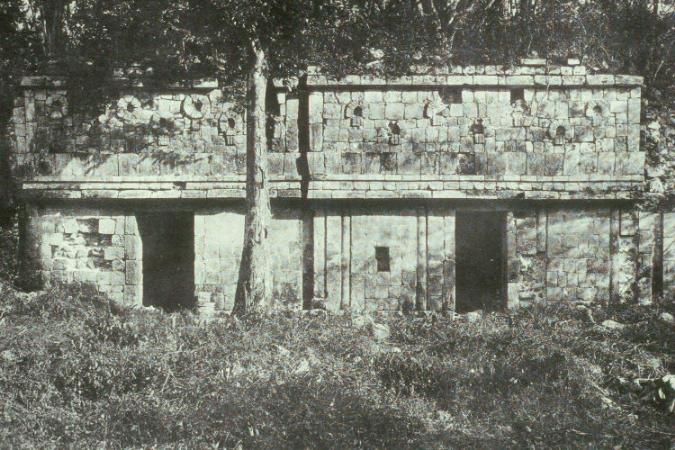
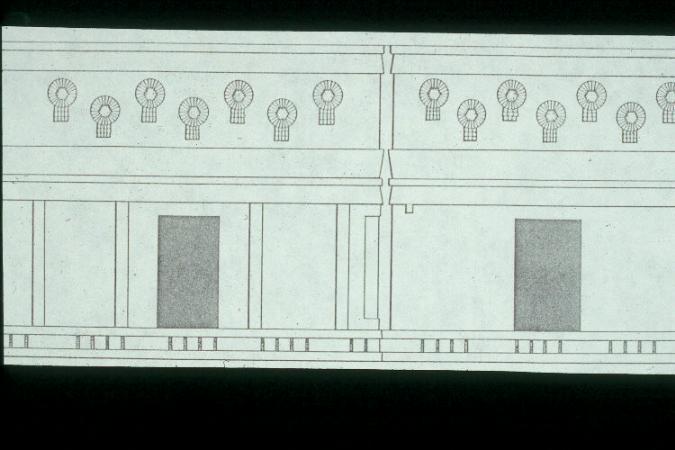
A building with remarkable similarities to the Casa de la Cacica stands
at the cite of Xkichmook, south of the Puuc hills in the Mexican state of
Yucatan.[vi] George F. Andrews dated it as circa 830 AD and
noted that:
The
use of large rosettes as decorative forms in the upper wall zone is unique and
there are no similar examples in either the Puuc or Chenes regions. Small
rosettes of similar design are used as decorative forms in the cornice moldings
of some classic Puuc buildings, particularly in the Late Uxmal style
buildings...the rosettes [at Xkichmook] should probably be considered as Puuc
inspired.[vii]
These
"rosettes" are floral representations, as are the decorative forms he
refers to on later buildings at Uxmal. Indeed,
Linda Schele refers to buildings
displaying this floral ornament as nikteil nah, or "Flower Houses."[viii] She
notes that these are the same as popol nah,
or the "mat houses" where "the councils of nobles and other
leaders met."[ix]
These "mat houses" are identifiable by the presence of sculptural
representations of woven reed mats on the facades.[x] Schele concludes that these "mat' or
"flower" houses have a long history in the architecture of the Maya.[xi]
Clearly in the Maya region -- from the ca. 830 transitional buildings at Xkichmook to the ca. 1000 Late Uxmal style buildings, to the Terminal Post Classic buildings at Tulum -- there is a persistence of meaning associating floral disks with high status activities.[xii] Given that Tulum was an inhabited and thriving city in 1518, it is safe to say that floral disk motifs were transmitting their meaning at various points in the Yucatan from 830 until 1518, or for nearly seven centuries. This demonstrates an enduring regional commonality of meaning in architecture. To be sure, there was some formal drift over time, but the disc frieze remained recognizable, and continued to be used only on a restricted number of special use, high status buildings.[xiii]
Slides
11 & 12
Code
Vindobonensis
Mitla
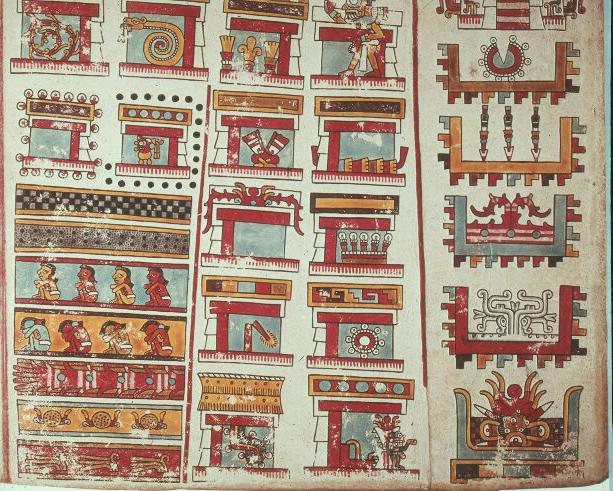
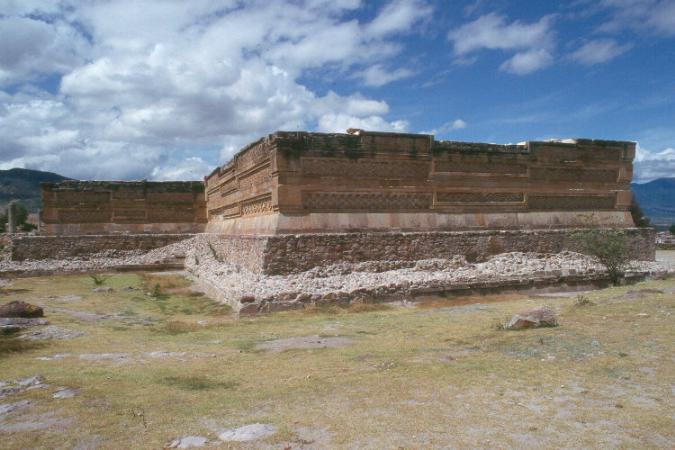
There are no known examples of standing pre-Columbian Mixtec disk frieze buildings, however there are numerous examples in the documentary record including those seen here from the Codex Vindobonensis. There are also at Mitla Late Post Classic standing buildings displaying friezes composed of various geometric patterns, some similar to those seen in the codex, perhaps recording genealogical information of those who built or used the complex. What seems clear is that these exquisitely constructed high status buildings transmitted an ideological meaning intended to be read from the friezes.
Slides
13 & 14
Close up of Double Concentric Ring disc, or Chalchihuite,
Nepopoalco,
Morelos
Feather
Mosaic of Mass of St. Gregory
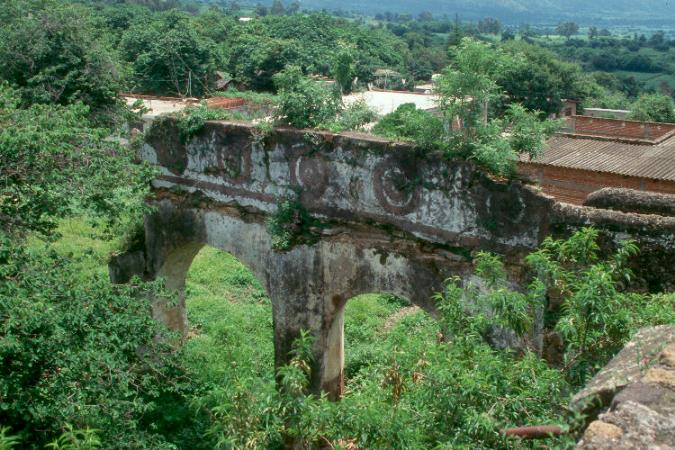
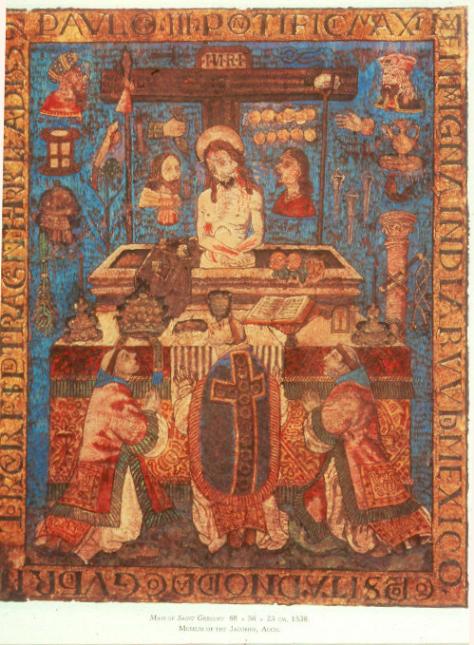
We may turn now to the Colonial era use of disk friezes. This pair of images illustrates the deliberate use of pre-Columbian double concentric ring disks symbolically representing chachihuites, or precious stones with pre-Columbian associations with water. On the left is the ruined early open chapel of San Juan Nepopualco, Morelos, and on the right a gift intended for the Pope made under the supervision of Pedro de Gante who certainly knew exactly what chalchihuites were. The feather mosaic depicting the Mass of Saint Gregory, though not an architectural example, nevertheless clearly shows that in 1539 there was in Tlatelolco a willingness by leaders of both cultural traditions to create a new art drawing on and blending symbols and techniques from their respective heritages to build a shared future.[xiv]
Slides
15 & 16
Xochimilco
Convento Church Facade
Xochimilco
Convento Church Facade, close up
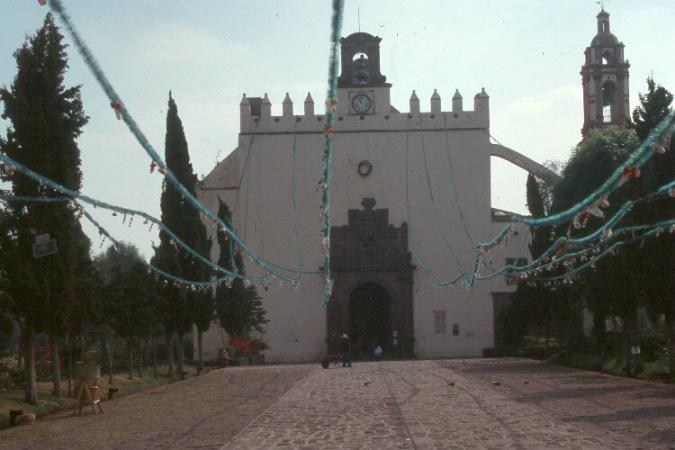
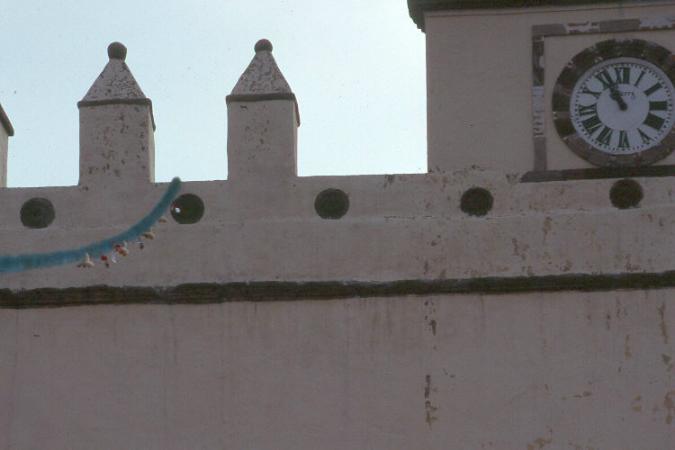
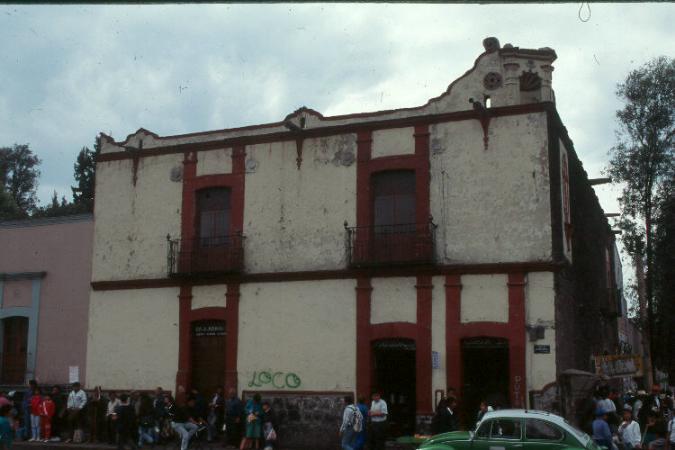
An example of early colonial era architectural use of disk frieze ornament may be seen here at the mid sixteenth-century Franciscan church of Xochimilco. The frieze along the top of the principal facade is composed of ten double concentric ring disks.[xv]
Slides
17 & 18
Xochimilco,
Casa del Cacique general view
Xochimilco,
Casa del Cacique, flower close-up
Also in Xochimilco, and not far from the Franciscan church, the cacique
Apochquizauhtzin, baptized as Don Luis Cortés Zerón de Alvarado built this two
story house in 1553.[xvi]
While no apparent axial alignments relate this building to the church or
convento complex, this casa del cacique
is located on the Zocolo, or central plaza where the local market, or tianguis,
still takes place within this plaza. Thus the building built for the cacique
still enjoys a prestigious location close to the center of community activity
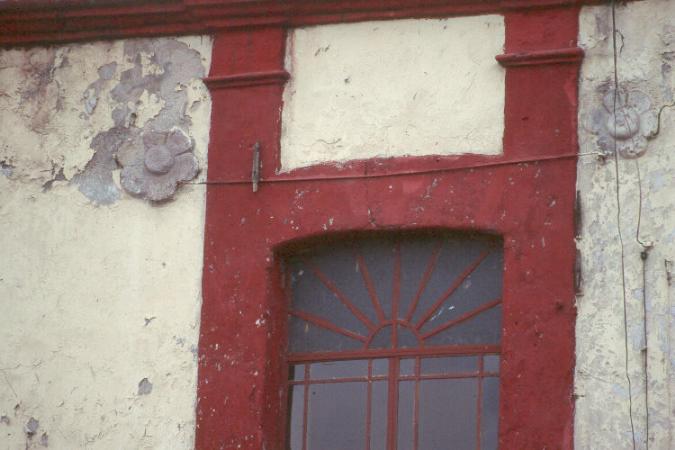
and commerce. High on the walls are the distinctive flower disks, which local
informants uniformly identified as dahlias, a favorite flower of the indigenous
nobility.
Slides
19 & 20
Xochimilco,
Casa del Cacique, flower close-up
Xochimilco
Museo de Arqueología, stone with Flower
At the archaeological museum a few miles away are two stone blocks with large pre-Columbian sculptural representations of flowers, one of which is similar to the forms on the cacique's house.
Slides
21 & 22
Atotonilco
de Tula, General View of Chapel
Atotonilco
de Tula, disc Frieze
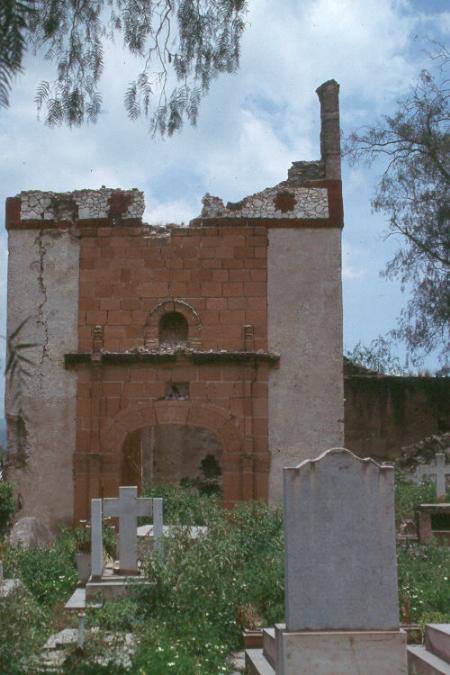
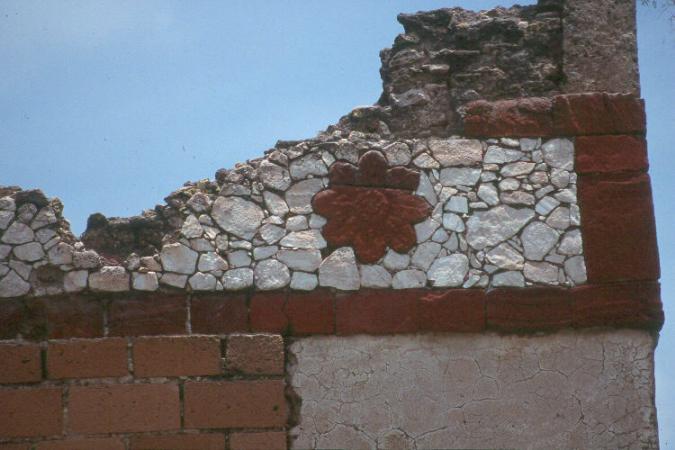
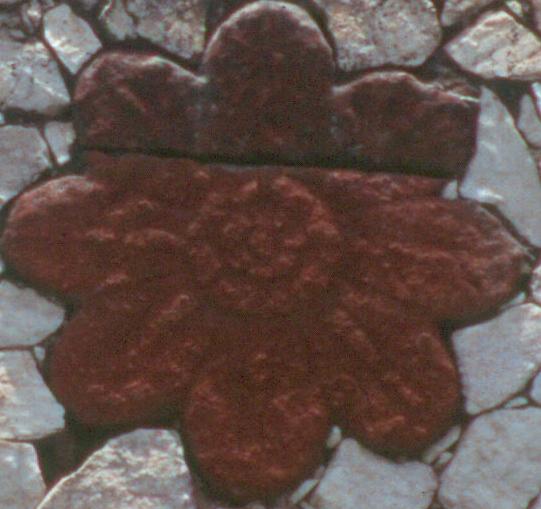
A striking example of disk frieze ornament on an early colonial religious building occurs in the northern Valley of Mexico at the cemetery chapel in Atotonilco de Tula, Hidalgo. Probably built in the 1540's, it is now in ruinous condition.[xvii] Here the disk frieze is used only on the principal facade, and displayed originally five red disks in a field of white mosaic stone surrounded with a matching red border.
Slides 23 & 24
Atotonilco de Tula, disc
close up
Flower, Dahlia
(after Helen O'Gorman. Mexican Flowering Trees and Plants. Mexico: Ammex
Asociados, 1961.)
There
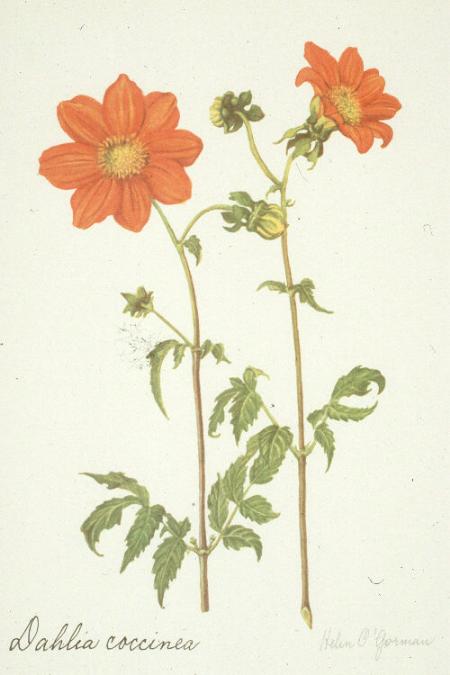
is a flower motif carved into the disks showing eight petals with a clearly
defined pair of rings, the inner most perhaps again composed of smaller petals.
These disks display clearly carved flower petals, perhaps of a dahlia, a
favorite among noble Indian connoisseurs, including Montezuma.[xviii] There was, in pre-Hispanic times, an
association of the cultivation of flowers for pleasure with high social status.
Concerning the importance of flowers, Serge Gruzinski
pointed out that among the elite the source of "heat" or power was
believed to be a divine force infused into the ranks of the Pipiltin that came
from Quetzalcoatl and Xiuhtecutli. He elaborated as follows:
This fire lodged in the
heart of the nobles was far from being a stable element: the rigors of penance
and the discipline of education increased its intensity, as did contact with
jewels, floral offerings, the scent of flowers, the consumption of the victims'
flesh, and even cacao. [xix]
This
corresponds with observations recorded by Fernando de Alva Ixtilxochitl,[xx]
a direct descendent the last king of Texcoco, in an account of the meeting of
Cortés and Moctezuma on the causeway. What is particularly interesting is the
detailed discussion of elaborately
prepared flowers in the ceremonial
event, recalling Gruzinski's "heat"
intensified by proximity to
flowers and their scents:
Motecuhzoma
now arrayed himself in his finery, preparing to go out to meet them. The other
great princes also adorned their persons, as did the nobles and their chieftains
and knights. They all went out to meet the strangers.
They
brought trays heaped with the finest flowers--the flower that resembles a
shield; the flower shaped like a heart; in the center, the flower with the
sweetest aroma; and the fragrant yellow flower, the most precious of all. They
brought garlands of flowers, and ornaments for the breast, and necklaces of
gold, necklaces hung with rich stones, necklaces fashioned in the petatillo
style.
Thus Motecuhzoma went out
to meet them, there in Huitsillan. He presented many gifts to the Captain and
his commanders, those who had come to make war. He showered gifts upon them and
hung flowers around their necks; he gave them necklaces of flowers and bands of
flowers to adorn their breasts; he set garlands of flowers upon their heads.
Then he hung the gold necklaces around their necks and gave them presents of
every sort as gifts of welcome.
Fernando
de Alva Ixtilxochitl's account here has the air of an informed observer, he may
have recorded a living memory of the event. Certainly the particular
distinctions of the types of flowers and the lavish use of flowers is most
interesting, and relevant to this discussion of the deliberate use of flower
imagery on early colonial buildings.
As we have seen in the numerous examples already cited, there was also in pre-Hispanic times a clear association of the disk frieze on buildings with particular high status individuals. The continuation of these associations of individuals with buildings expressed by the disk frieze ornament in early colonial architecture was intended to perpetuate the ideological message, in this case linking a native lord with a new Christian temple. In this way, even if it was no longer possible to publicly preside over the religious ritual performance, still there was a permanently visible stamp of high status association openly and obviously linking the indigenous leader with the new temple.
Slides 25 & 26
Tlayacapan Palacio
Municipal
Tlayacapan
Palacio Municipal close-up of disc
Another
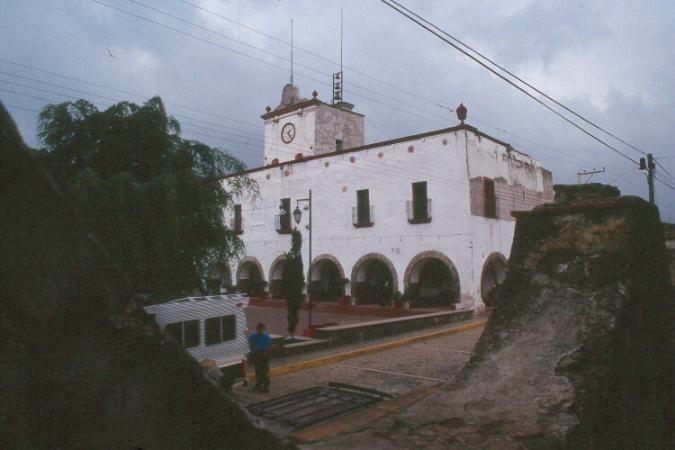
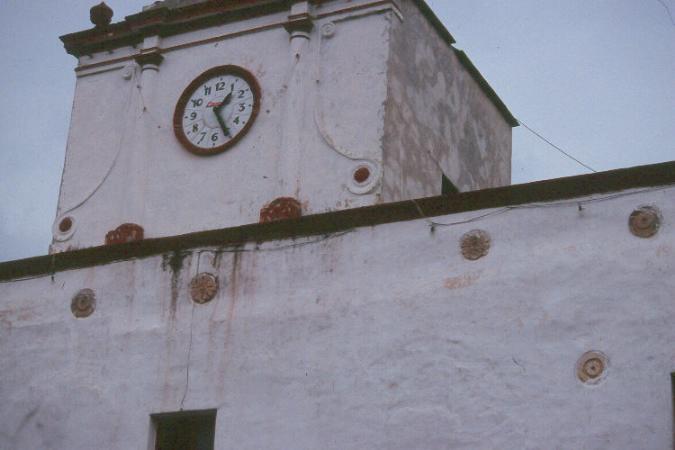
use of the Disk Frieze survives in fragmentary form at the two story Municipal
Palace located on the Plaza of Tlayacapan in Morelos, where an incomplete row of
disks appears along the top of the building, alternating between an eight
petalled flower and a disk composed of two concentric rings.[xxi] While the frieze is incomplete, there is a
double concentric ring lower on the wall near one of the windows. According to
the President of the Municipality, this building was built before the well known
Augustinian convento next door and was used as a temporary residence for the
friars who moved to the convento when it was completed. Then the building was
used as the Cabildo for the local government, according to the President. Of
course, the local government, or Cabildo would have been composed of the
indigenous leaders of the area. The convento dates from 1555, and Kubler says
that the Augustinians took up residence in Tlayacapan in 1554.[xxii]
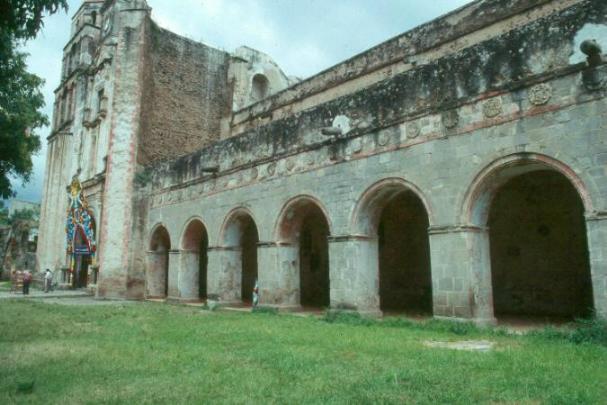
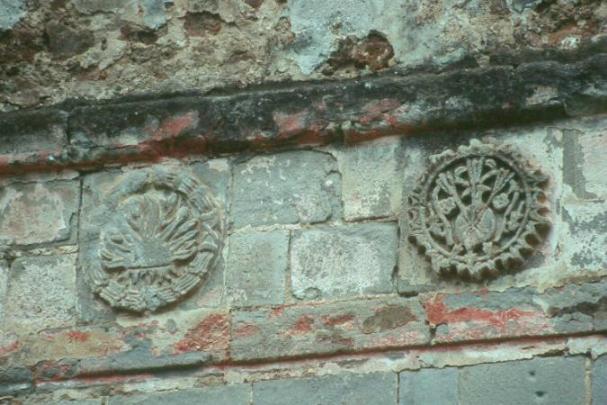
Slides 27 & 28
Malinalco Convento, View
of porteria
Malinalco Convento Disk
Frieze
At Malinalco, an Augustinian house founded in 1543 and completed by 1568, there is another clearly visible example of disks arranged in a frieze along the cornice above porteria/open chapel.[xxiii] Here the disks are obviously colonial era work, and rather than floral motifs, they have Spanish style motifs and one disk with representation of twisted grass, the place glyph for Malinalco.[xxiv] Nevertheless, the frieze is bordered by carefully cut stone, as at Atotonilco de Tula and elsewhere, but in this case rather than being of red stone, the stone was painted red, and the field was dressed quarried stone rather than mosaic, but painted white.[xxv] It is safe to assume that this slightly modified disk frieze at Malinalco, openly and obviously incorporating European iconographic motifs of unmistakably Christian meaning in a distinctively pre-Columbian architectural feature was executed with the willing consent of the Augustinian friars. It is also a certainty that the friars had no illusions about its historical antecedents in pre-Columbian architecture, many examples of which were no doubt still much in evidence on standing buildings when this convento was built. This shows a willingness if not a deliberate intention on the part of the friars to incorporate or integrate ideologically significant pre-Columbian architectural elements but with a deliberately "renegotiated" iconographic content. The disks in this frieze include the recognized Malinalco place-glyph adjacent to a disk bearing the pierced heart symbol of the Augustinian order on the right and the IHS monogram of Christ. Thus this disk frieze adorning the Augustinian house at Malinalco provided a recognizable medium for ideological expression and transmission deliberately fusing well known pre-Columbian forms with new European elements in a new, visible, creative outcome of the process of cultural change through willing negotiation and consent.
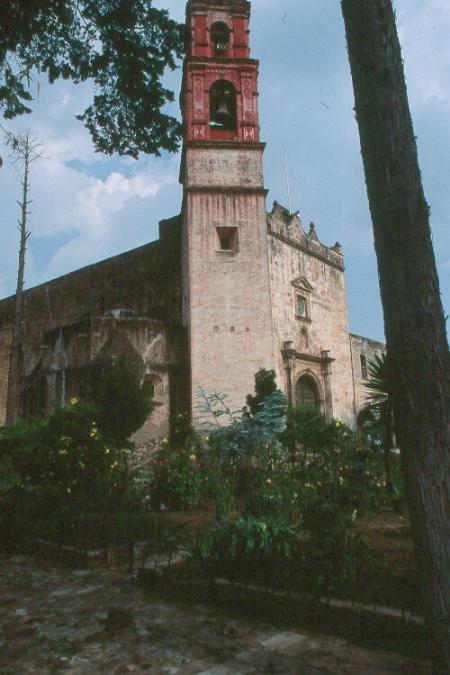
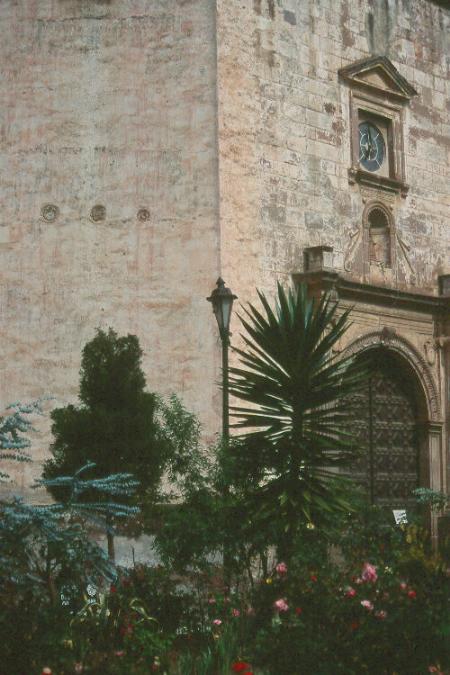
Slides 29& 30
Tlalmanalco Convento
Church Tower view
Tlamanalco tower 3 discs
close up
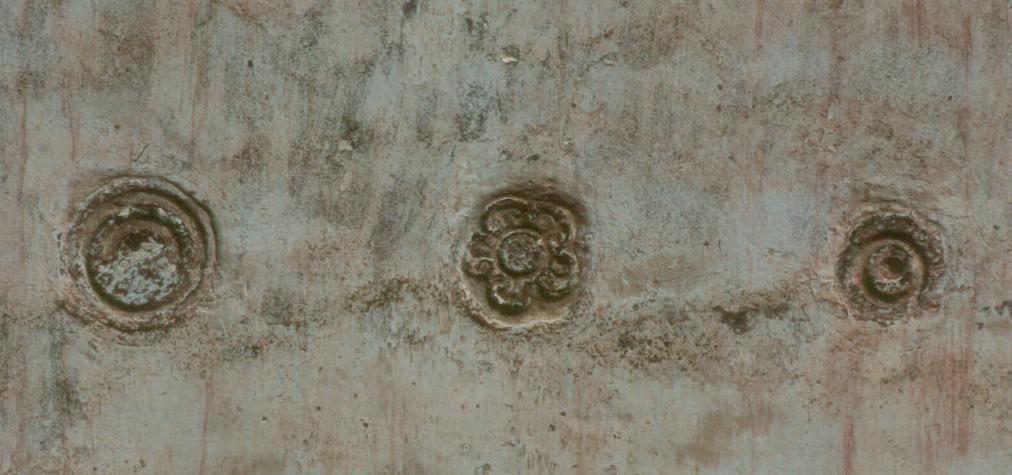
At Tlamanalco there is yet another example of the use of pre-Columbian disks to ornament a location of Christian ritual performance. On the circa 1585 tower there is a horizontal arrangement of three disks openly and obviously displayed in a prominent location.[xxvi] The two outside disks are of the double concentric ring type, the one in the center is of the floral motif type, but with five petals.
Slides 31 & 32
Xochipili
After Levenson, 1992
Xochipili
After Levenson, 1992
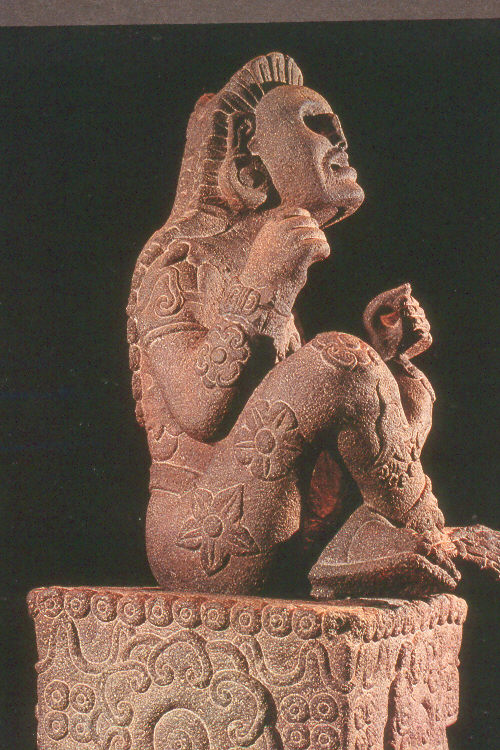
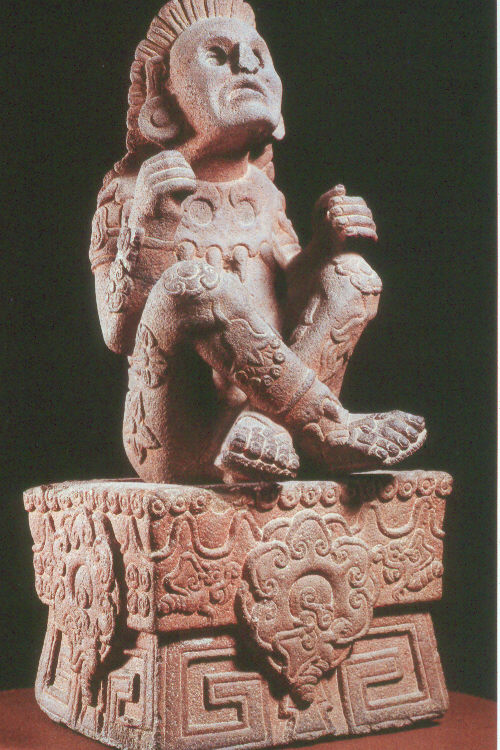
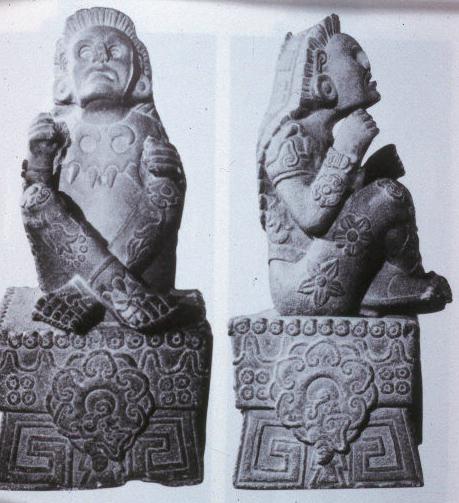
There is a close similarity between the way that these five petals are expressed and the petals of the flowers on the knees and forearms of the "Prince of Flowers," or Xochipilli.[xxvii]
Slides 33 & 34
Tlamanalco tower disc
close up
Xochipili Arm flower
The statue was discovered in the last decades of the nineteenth century in the village of Tlamanalco.[xxviii] The "Prince of Flowers" was thought to be the supreme patron of the greenness of the fields, responsible for the opening of the flowers that bring butterflies and birds. Xochipilli was also the god of dances, of games (including the ball game), of gambling and of love.[xxix]
Slides 35 & 35
Yolomecatl Tower
Yolomecatl Tower discs
close-up
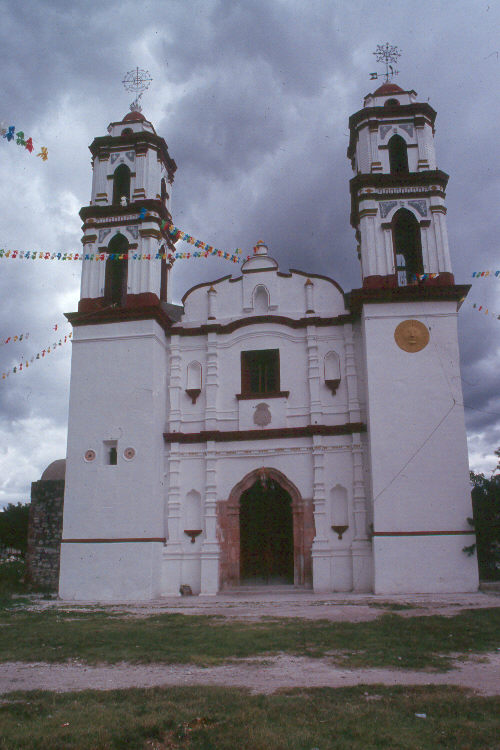
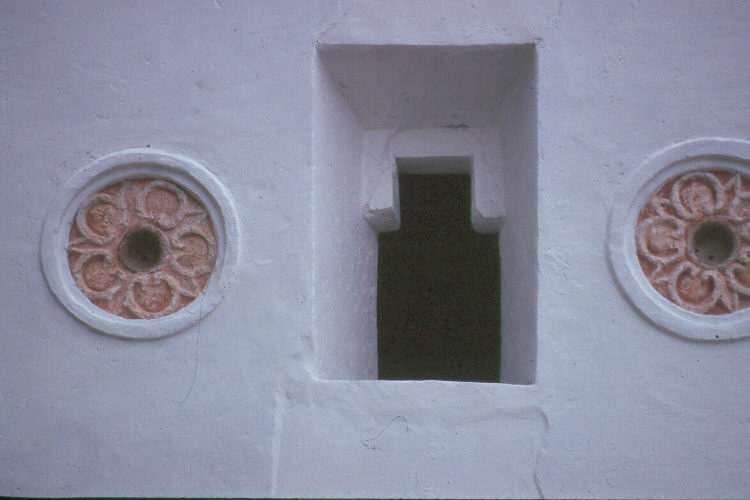
Another pair of discs with a floral design showing elements quite similar to what we have just seen at Tlamanalco appear on the church tower at Yolomecatl near Teposcolula. In the early sixteenth century Yolomecatl was a community under the authority of the rulers of Teposcolula. In a moment we will examine more closely the disk frieze at Teposcolula and the carvings on the now much weathered discs. These disks at Yolomecatl are much less eroded, much crisper, and clearly have the same pattern carved on them, with some slight variation suggesting another sculptor made them at a different time but perhaps with the same archetype in mind.
Slides 37 & 38
Malinalco Cross
Malinalco Cross Close-up
For further clues,
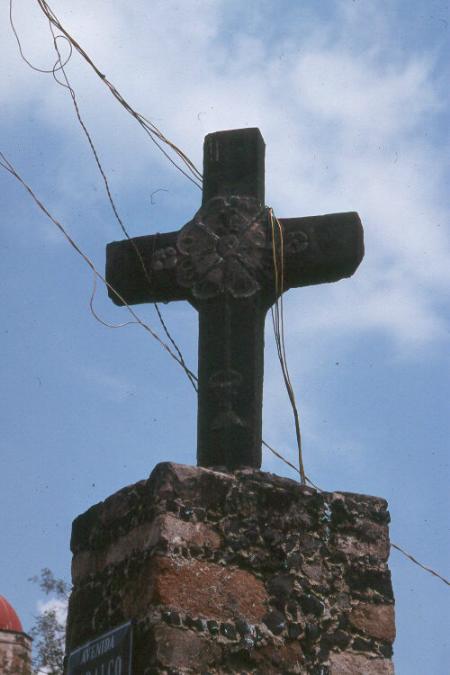
let us turn for a moment to an unusual cross at Malinalco that was
probably an original atrio cross. It is now mounted on the corner of the atrio
wall. Prominently displayed
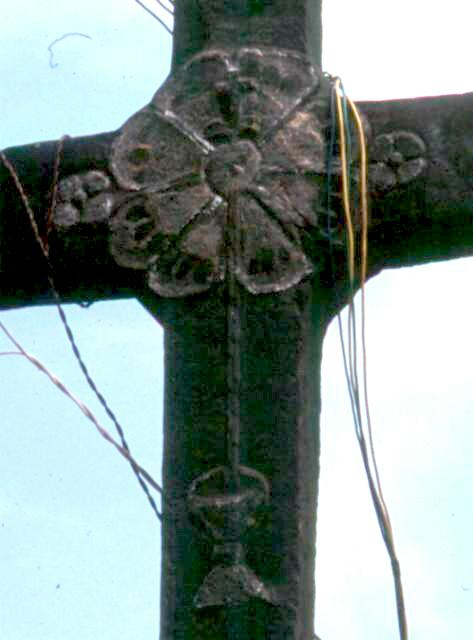
is what appears to be a representation of an eight petalled flower.[xxx] Appearing in relief is a small cross, piercing
the flower, a possible reference to the Spear of Longinus of the Passion. From
the wound created by the cross piercing the flower flows a stream of blood into
a chalice shown in relief below the flower, referring to the sacramental symbols
of Christ's Body and Blood. Taken together, this iconographic complex is a
representation of the mystery of the Eucharistic Miracle, Christ's presence in
the consecrated Host, the sacrament of the new religion with which His once for
all time self-sacrifice is ritually reenacted. Given the frequency of Passion
iconography on atrio crosses, it is not surprising to find such a message carved
on a teaching tool from the early years of the evangelization.[xxxi]
However the use of flower imagery
in religious iconography was a practice common to both Late Medieval
Christianity and Late Post Classic Mesoamerican traditions.
This is undoubtedly colonial era work, but it shows a blending, or
integration of highly significant meanings and symbols from the pre-Columbian
and Christian iconographies, carried out and displayed prominently under the
close supervision of the friars, in a process of willing negotiation and
consent.[xxxii]
Slides 39 & 40
left
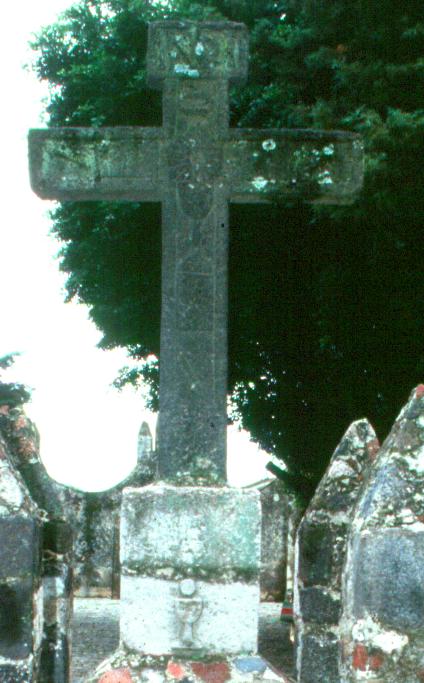
Yecapixtla Cross
right
Ceramic
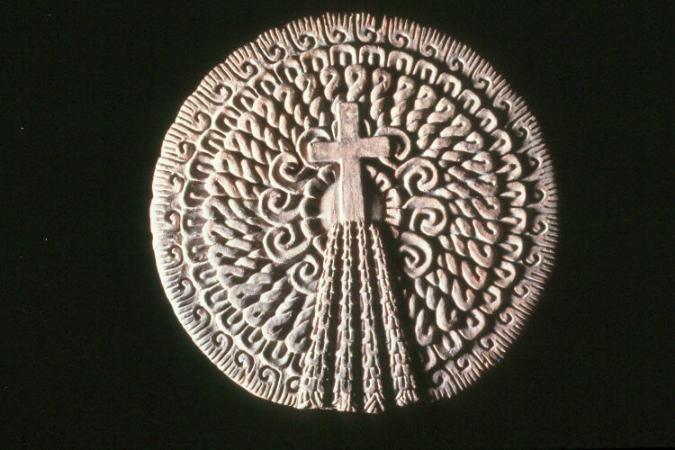
disk from San Juan Teotihuacan, Field Museum, Photo by John Carlson
Another
example of the association of the atrio cross and the pre-Columbian flower motif
occurs at the Augustinian convento at Yecapixtla, built after 1541.[xxxiii]
On top of the stone base into which the cross is set there is a chalice
and Host in relief on the plinth of the cross, and on the cross there are three
nails in relief and at the crossing what appears to be the Host represented as a
flower, or perhaps a sunburst, with a circular void in the center and a tiny
cross above the center, as at Malinalco, with the chalice beneath it on the
shaft of the cross, again as at Malinalco.[xxxiv]
Above the Host is the Crown of Thorns, symbolically referring to the Crucified
Christ. As at Malinalco, there is a coming together of pre-Hispanic and
Christian symbolic metaphors: the pierced flower, which looks like the
sacramental wafer, refers to the Eucharistic miracle, the presence of Christ in
the Host.
Pictured on the right is a ceramic disk from San Juan Teotihuacan, originally evangelized by the Augustinians in 1557.[xxxv] This disk displays a flower made up of a variety of motifs, including step-frets, of distinctly pre-Columbian inspiration, and at the center is a cross piercing the center of the flower, and blood appears to be flowing from this wound. Given the similar iconography found in the two other contemporaneous Augustinian houses discussed above, this dish may date from prior to 1563, or during the Augustinian activity.
Slides 41 & 42
Tlalhuelilpa Atrio
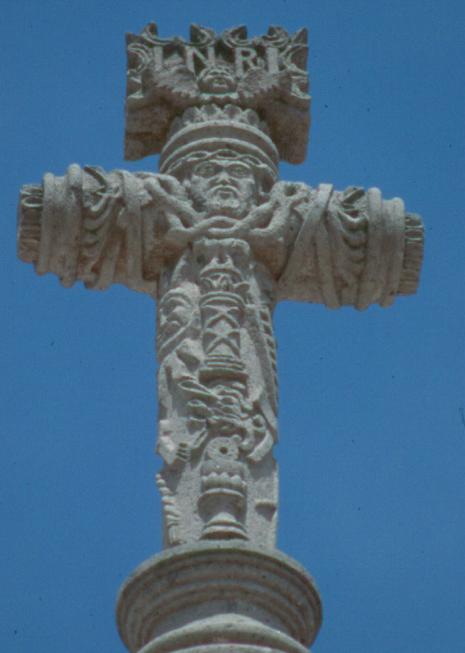
Cross
Tlalhuelilpa Cross,
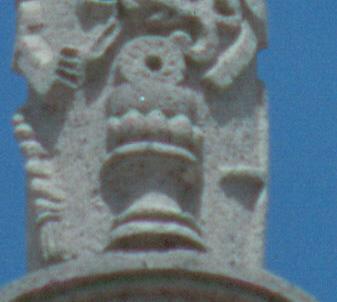
detail showing Host and Chalice
The atrio cross at the
Augustinian house at Tlahuelilpa, now mounted over the facade, shows the Host in
the Chalice, a common iconographic occurrence in sixteenth-century Mexico. But
here the Host is a multilobular disc with a hollow center, like the disks we see
at Teposcolula and Yolomecatl. This reinforces the interpretation I will propose
for the discs at Teposcolula: that
they were a symbolically integrative visual device referring to sacramental
food, the consecrated Host of the new religion and to a pre-Columbian sacrament
such as the Ololiuqui. In other words, there was a deliberate visual conflation
of the two symbols by indigenous leaders advancing their own ideological agenda
by maintaining their traditionally
close association with sacramental activity.
THE DISK FRIEZE AT TEPOSCOLULA INTERPRETED
Slides 43 & 44
Casa de la Cacica
Casa de la Cacica, disc
frieze
Iconographic symbolism in buildings, as distinct from specific articles
of devotional art, carries significance in more general, more layered, multiple
meanings, therefore interpretation must be suggestive rather than definitive.[xxxvi]
With this and the above examples in
mind, I will now propose an interpretation of the various possible meanings
intended by the Casa de la Cacica of Teposcolula.
We have seen in the five lobed disk
at Tlalmanalco what appears to be a reference to psychotropic plants used
in
prehispanic Nahua religious ceremony. These plants had a powerful effect on
those who ate them. They were referred to metaphorically as the flesh of God,
and partaking of them led to mystic experience and contact with the divine. At
Malinalco and Yecapixtla flowers appear to be represented on the atrio crosses
in a way suggestive of sacramental
significance because the flowers resemble the shape of the Christian sacramental
wafer, because the flowers are pierced by a cross, and because a chalice is
shown below them, apparently receiving the Blood of Christ. This symbolism
suggests that the presence of Christ in the Host is like the presence of God in
the psychotropic plants. Eating the flesh of God is, in both cases, a
sacramental, transforming act expressing symbolic and mystical communion with
God. And the use of a flower symbol might have had the added advantage of
expressing the relationship of the sacrifice of Christ on the Cross with the
Eucharistic Miracle of the Mass in recognizable terms referring to similar
significance from the pre-Columbian symbolic lexicon.
Every example of early colonial era disk or disk frieze ornament I have found has occurred either in a location of Christian religious significance, or on a building associated with indigenous rulers.[xxxvii] In the pre-Columbian era, the indigenous elite controlled religious activity and access to the sacraments, and to the divine, the ultimate source of power and legitimacy. The coming of the friars officially terminated their control of religious activity, although they were welcomed as participants in the new religion, and often took leading roles in Christian religious life as laymen.[xxxviii]
Slides 45 & 46
Casa de la Cacica, disk
multilobular
Casa de la Cacica, disk
round
I suggest that the use of the Disk Frieze ornament at the Casa de la
Cacica was employed by the native leaders to make a visual, architectural
statement alluding to their legitimacy as rulers by the use of the recognized
pre-Columbian symbolism denoting royal residences, but also using their palace
as an architectural expression of the leadership role they wished to maintain
under the new religious system.
The disks at the Casa de la Cacica have similarities with the other disk
frieze buildings we have seen. As at Xkichmook, Tulum, Atotonilco de Tula, and
the Casa at Xochimilco, among others, at Teposcolula the disks depict distinctly
petalled flowers with a deep central cavity suggesting a sculptural
representation of some trumpet shaped flower. Furthermore, as at Tulum and
Tlayacapan, among others, the disks alternate between a round and a multilobular
outline, as if to distinguish between two types of flowers in a stylized but
effective abstraction.
On 5 November 1994 I showed Dr. Leslie Garay, recently retired from the
Harvard Botanical Museum, a series of slides from my field work.[xxxix]
He confirmed that the botanical identities of the flowers on the disks at Casa
de la Cacica of Teposcolula are Tlapaltic-
Cataloxóchitl, or Datura stramonium,
and ololiuqui, or Turbina corymbosa.
Ground seeds of Tlapaltic-Cataloxóchitl
and ololiuqui were taken in
pre-Columbian times to produce visions and to cause a certain kind of
intoxication accompanied by hallucinations which were then interpreted "como
adivinación."[xl]
Doris Heyden's dissertation on floral symbolism in pre-Columbian
iconography emphasized that in pre-Columbian times
flowers, like society itself, had their own hierarchy.[xli]
Furthermore, the cultivation, cutting, and use of flowers, and even the use of
flower imagery, was systematically regulated and controlled according to strict
rules of hierarchy enforced, even among the nobles, by severe penalties,
including death. Images of specific flowers were worn on clothing as badges of
rank.[xlii]
She stated that in particular the
Tlapaltic-Cataloxóchitl
was reserved for the exclusive use of monarchs and nobles.[xliii]
Based on Garay's confirmation and Heyden's findings, then, I propose that
the use of sculptural representations of Tlapaltic-Cataloxóchitl on the disks of the Casa de la Cacica was
deliberately intended to iconographically reinforce the architectural statement
that this was indeed the house of someone very privileged, a fine and proper
house for a royal couple.
Like the flower disk on the cross of Malinalco, the round white disks on the Casa, resemble the round white Hostia of the Mass, at least formally. The visual association of the organic psychotropic sacraments, once the prerogative of the native rulers and recognizable in the disks, with the new Christian sacrament(s) may have been employed by the native rulers as a means of cultural integration, to associate themselves with the prestige of sacramental activity of the new religion.
Slides 47 & 48
Casa de la Cacica close
up
1955
Airview computer enhanced by Daniel diMarco
Certainly the location of the royal palace, higher than but in direct
alignment with open chapel, and overlooking the atrio and town from a commanding
position, visually conveys the message that this is the highest status dwelling
in the town. No other dwelling was privileged with such a direct relationship to
the ceremonial center. Furthermore, the use of the Disk Frieze ornament, with
its implied religious connotations symbolically includes, or attaches the royal
residence to the new sacred precinct in the atrio below.
Another possible layer of meaning further reinforcing the relationship of the native royal couple with the devotional practices of the new religion, perhaps intended to focus some of these practices on the royal palace and indirectly on the royal couple, may help to explain the numerical grouping of the disks. In the catechism lessons taught by the friars important dogmatic concepts were presented in four groups of seven, perhaps for ease in recollection and recitation: the Seven Sacraments, the Seven Articles of Faith, the Seven Works of Corporal Mercy, the Seven Acts of Spiritual Mercy.
Slides
49 & 50
North
Door at Coixtlahuaca
Open-Chapel
at Teposcolula
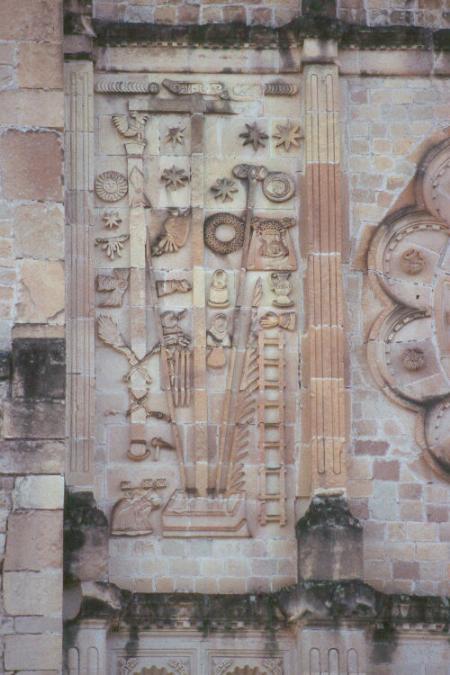
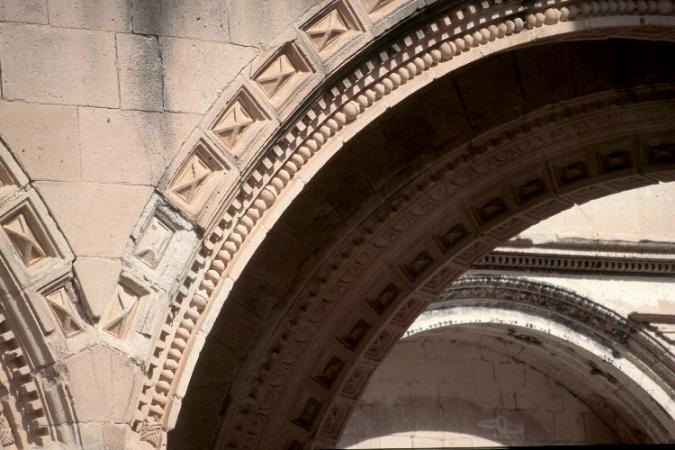
As may be seen in the case of the Passion iconography displayed at Coixtlahuaca and the Rosary beads displayed over the great stone arches of the open chapel of Teposcolula directly facing the Casa, the friars deliberately used mnemonic devices prominently displayed on architecture to implant and reinforce Christian devotional practices.[xliv]
Slides 51 & 5 2
Casa
de la Cacica
Casa de la Cacica
It
is possible that the native leadership of Teposcolula, which had clearly
cooperated with much else, was willing also to cooperate, for their own reasons,
in this use of architecture to display mnemonic iconographic aids to Christian
devotion. And particularly if it would contribute to their own prestige. This
blurring or overlapping of sacramental symbolism on the rulers house may not
have been accidental.[xlv]
Such a reference prominently displayed on the royal palace, as a mnemonic
reminder to the new catechists looking on from the atrio below, may have indeed
pleased the friars, and it certainly included or integrated the rulers'
residence in the overall system of ceremonial and symbolic transmission.
It may be nothing more than coincidence that these four groups of seven
disks appear in the friezes, but there is one more piece of the puzzle worth
mentioning which suggests a coordination, if not competition, with the
iconographic program of the open chapel. On each of the end walls of the Casa
there are eight disks in the frieze. Taking this eight and adding to it the
seven from the next group of disks in the frieze of the long wall makes fifteen
disks, or counters if the mnemonic theory holds. This would correspond to the
fifteen mysteries of the Rosary. If this speculation on the possible numerical
significance is accurate, it would further demonstrate a highly complex and
deliberate layering of meaning.
But even without the numerical dimension, the other evidence leaves it
beyond doubt that this building was built to take a prominent place in the new
sacred landscape, transmitting by the disk frieze a message of continuing
royal legitimacy and prestige. Thus the open and obvious combination of
distinctly Mesoamerican pre-Hispanic architectural form and ornament with
distinctly Spanish architectural form and ornament placed in direct alignment
with the altar of the new ceremonial center may be viewed as a statement of the
native ruling couple's continuing role as religious mediators, in this case
between the old and the new cult.
Slide
List
1.)
Casa de la Cacica close up
2.)
Casa de la Cacica Long view showing alignment
3.)
Tulum general view acropolis
4.)
Tulum Temple of Diving Gods, general view
5.)
Tulum Temple of Diving Gods, close up discs
6.)
Marquina diagram
7.)
Kichmook, Maler photograph
8.)
Kichmook, line drawing
9.)
Code Vindobonensis
10.)
Mitla
11.)
Close up of Double Concentric Ring disc, or Chalchihuite
12.)
Feather Mosaic of Mass of St. Gregory
13.)
Xochimilco Convento Church Facade
14.)
Xochimilco Convento Church Facade, close up
15.)
Xochimilco, Casa del Cacique general view
16.)
Xochimilco, Casa del Cacique, flower close-up
17.)
Xochimilco, Casa del Cacique, flower close-up
18.)
Xochimilco Museo de Arqueología, stone with Flower
19.)
Atotonilco de Tula, General View of Chapel
20.)
Atotonilco de Tula, disc Frieze
21.)
Atotonilco de Tula, disc close up
22.)
Flower, Dahlia
23.)
Tlayacapan Palacio Municipal
24.)
Tlayacapan Palacio Municipal close-up of disc
25.)
Malinalco Convento, View of porteria
26.)
Malinalco Convento Disk Frieze
28.)
Tlalmanalco Convento Church Tower view
29.)
Tlamanalco tower 3 discs close up
30.)
Xochipili
31.)
Xochipili
32.)
Tlamanalco tower disc close up
33.)
Xochipili Arm flower
34.)
Yolomecatl Tower
35.)
Yolomecatl Tower discs close-up
36.)
Malinalco Cross
37.)
Malinalco Cross Close-up
38.)
Yecapixtla Cross
39.)
Carlson's dish
40.)
Tlalhuelilpa general view
41.)
Tlalhuelilpa Cross
42.)
Casa de la Cacica
43.)
Casa de la Cacica, disc frieze
44.)
Casa de la Cacica, disc multilobular
45.)
Casa de la Cacica, disc round
46.)
Casa de la Cacica close up
47.)
Casa de la Cacica Long view showing alignment
Notes:
[i]. Portions of this paper appeared in my "Architectural Fusion and Indigenous Ideology in Early Colonial Teposcolula: The Casa de la Cacica, Teposcolula, Oaxaca, Mexico: A Building at the Edge of Oblivion" presented at the 48th International Congress of Americanists, "Threatened Peoples and Environments in the Americas," Stockholm, Sweden, 4-9 July 1994 in the Symposium "Latin American Colonial Architecture and Urbanism on the Fringes." The paper was subsequently revised and published in the Anales of the Instituto de Investigaciones Estéticas of the Universidad Nacional Autonoma de México, No. 66, pp. 45-84, benefiting from comments made by the discussants Elisa Vargas Lujo and Damion Bayon and other members of the symposium, especially Humberto Rodriguez-Camilloni, Sydney Markman, Clara Bargellini, and Robert Mullen. Further field research was made possible by a generous dissertation year fellowship awarded by the Social Science Research Council and the American Council of Learned Societies supported by the Andrew W. Mellon and the Ford Foundations. I wish also to acknowledge the unfailing hospitality in Nashville and kindness over several seasons in the field of Ronald Spores. In Oaxaca Juan I. Bustamante opened his Institute to me and introduced me to Dr. Frank Hale whose bibliographical suggestions and extensive research library did much to shape the direction of the research presented in this paper and permitted an important breakthrough in the interpretation of the discs at Teposcolula.
[ii]. This is a parallel meaning with the Mixtec supernatural Dzahui.
[iii]. For a suggestive paper on trade and transmission of architectural forms in the Classic Maya period, see Rathje, William L. "Trade Models and Archaeological Problems: The Classic Maya and their E- Group Complex." in Atti del XL congresso Internazionale degli Americanistii, Roma Genova 3-10 Settembre 1972 . Genova: Tilgher, 1972, Vol IV, pp. 223-238.
[iv]. (like a bifurcated snake's tongue seen elsewhere in Mesoamerican iconography) See reconstruction drawing by Miguel Angel Fernández in: Marquina, Ignacio. Arquitectura prehispánica. México: Instituto Nacional de Antropología e Historia, facsimile 1990], p. 817.
[v].
Moreover, it is worth noting
the Late Post Classic mural paintings of Tulum,
published by Arthur G. Miller among others. Miller pointed to
suggestive similarities with Mixtec art. Miller, Arthur G. "The mural painting in
Structure 12 at Tancah and in Structures 5 at Tulum, Quintana Roo, Mexico:
implications of their style and Iconography." in Atti del XL
congresso Internazionale degli Americanistii, Roma Genova 3-10 Settembre
1972 . Genova: Tilgher, 1972, Vol 1, pp. 465-472; and his later On
the Edge of the Sea: Mural Painting at Tancah-Tulum, Quintana Roo, Mexico.
Washington DC: Dumbarton Oaks, 1982. Even
earlier Ignacio Marquina had also suggested a Oaxaca connection, noting of
the Tulum paintings:
En general, no tienen el
carácter de las pinturas realistas que se hallan en lo Zona Maya, como las
de Bonampak, las de Chacmultún o las de Chichén-Itzá, en las que se
representan bataillas, fiestas o diversas escenas de la vida diaria; se
asemejan más a los dibujos de algunos códices y las que existen en Mitla.
Marquina,
Arquitectura prehispánica. p.
823.
Indeed, close visual examination of the murals at Tulum and those in the Church Group at Mitla, generally considered Late Post Classic Mixtec work, reveal striking formal similarities. Indeed, as Mary Miller pointed out, "The palette of these works is limited to red, blue, and yellow, all outlined in black. Stiff conventional gestures as well as the proportional system suggest influences from Late Postclassic Mixtec painting." Miller, Mary Ellen. The Art of Mesoamerica from Olmec to Aztec. London: Thames and Hudson, 1986, p. 192. Miller added that though there may have been Mixtec influence, the glyphs accompanying these murals were strictly Maya, demonstrating that they were intended for a Maya audience.
[vi]. Using a photograph by Maler from the 1890s, Marquina referred to it as "Palacio con Medallones." Marquina, Arquitectura prehispánica. p. 735. See also Barrera Vazquez, Alfredo, et al. Arte Maya: Uxmal, Sayil, Labna, Kabah Y Region Puuc. México: Editora del Sureste, 1981, p.192, and Pollock, H. E. D. The Puuc: An Architectural Survey of the Hill Country of Yucatan and Northern Campeche, Mexico. Boston: Peabody Museum Memoirs, Volume 19, 1980. George F. Andrews published the most comprehensive treatment of the site to date, including several good recent photographs, plans, elevations and sections of this building which he referred to as Structure 12. See: Andrews, George F. "Xkichmook Revisited: Puuc v. Chenes Architecture." Cuadernos de arquitectura mesoamericana 1(feb. 1984):49-88.
[vii]. Andrews, "Kichmook...," p. 83.
[viii]. Schele, Linda. "The Iconography of Architectural Facades during the Late and Terminal Classic Period." Unpublished paper given at Dumbarton Oaks symposium on Meaning in Mesoamerican Architecture, October 8, 1994. Dr. Schele kindly gave me a copy of this paper at the conference. Discussion of Mat and Flower Houses begins on page 17.
[ix]. As identified by Barbara Fash. Schele cities personal communication with Stephen Houston. and: Fash, Barbara, et al. "Investigations of a Classic Maya Council House at Copán, Honduras." Journal of Field Archaeology 4(1992): 419-442, pp.434-436.
[x].
This immediately calls to
mind the numerous pictorial representations of Mixtec ruling couples seated
on their mats in the Mixtec codices, as discussed by Kevin Terraciano. Ñudzahui
History: Mixtec Writing and Culture in Colonial Oaxaca,
Ph. D. dissertation, University of California at Los Angeles, 1994.
[xi]. She notes that they are relatively rare in the southern lowlands, but are more abundant in the northern zone. Schele. "The Iconography of Architectural Facades..." p. 27.
[xii]. Mary Miller suggests the Tulum structures were thirteenth century or later Miller. The Art of Mesoamerica. p. 192. However, S. K. Lathrop, Tulum. Washington D.C.: Carnegie Institute, 1924, felt the buildings were fourteenth century or later, contemporary with Mayapan, and George Kubler, The Art and Architecture of Ancient America. London: Penguin Group, 1990, p. 321, argued for eleventh century. I am more inclined to agree with Lathrop, based upon visual inspection in situ. But as Kubler pointed out, the buildings were often rebuilt, so what we see may well be results of several campaigns stretching over a long period, and the murals may be more recent than the masonry under them, as at Mitla.
[xiii]. The mural paintings at Tulum and Mitla indicate some kind of cultural connection between the Maya area and the Mixteca. It is at least possible that contact such as this contributed to the use of disk frieze ornament in both areas, suggesting a broader, inter-regional commonality of meaning, as was noticed in the case of the mats connoting high status common to both areas. Other than chronological inferences, the available evidence would not strongly support speculation suggesting of diffusion of disk frieze ornament moving in one direction or the other. But the chronology does point to the use of disk friezes in monumental high status buildings at ceremonial centers in the Yucatan earlier than in the Mixteca, indeed perhaps earlier than the Late Post Classic culture commonly associated with the Mixteca-Puebla style.
[xiv]. See: Elena Estrada de Gerlero, Catalogue note on this item in: Metropolitan Museum of Art. Mexico: Splendors of Thirty Centuries of Art. New York: Bullfinch Press/Little, Brown and Co., 1990. For a superb volume, richly illustrated with extraordinarily high quality photography devoted to the art of feather mosaic from pre-Columbian times to the present,, including an in-depth treatment of this piece, see: Banomex. La Plumeria. México: Fondo Cultural Banomex, 1994(?).
[xv]. There are several smaller examples in the city as well, including the Capilla de San Francisco which displays three double concentric ring disks on its principal facade.
[xvi]. INAH. Catalogo Nacional Monumentos Históricos Inmuebles Xochimilco, D.F.. México: INAH, 1987(?), p. 119.
[xvii]. Kubler, Mexican Architecture.... p. 452-3, noted that the Franciscans evangelized this area, perhaps before 1547 when the population was listed, according to Catálogo...Hidalgo, at 820 tributaries. Kubler said that the main church in the town, some miles from this small chapel which he did not mention, was an Augustinian establishment from c. 1560 with links to Acolman and Yecapixtla. The proximity of this community to the large Franciscan center at Tula inclined Kubler to believe that the Franciscan presence in Atotonilco de Tula was dependent on the larger house at Tula. Kubler notes (p. 484) that the Franciscans were active at Tula beginning in 1529, built a primitive church there before 1546, and replaced it with the current edifice after 1550, and the Convento from 1553-61. I am inclined to think that the Cemetery Chapel at Atotonilco de Tula may be a survival from the initial Franciscan evangelization, and that it dates from the 1540's. The Augustinian Church in the center of the town today may have been built as part of a new town built to congregate the people in an urban environment, not unlike the sequence in Teposcolula. An old photograph, probably from the 1930's, appeared in Luis Mac Gregor. El Plateresco en México. Mexico: Editorial Porrua, 1954, pl. 78. Considerable deterioration has occurred since this photograph was taken, calling attention to the need for an immediate preservation intervention at this important and extremely rare site of transitional architecture.
[xviii]. O'Gorman, Helen. Mexican Flowering Trees and Plants. México: Ammex Associados, 1961, p. 154. She wrote: "Very few people outside of Mexico know that the dahlia was originally Mexican, an imperial jewel in the time of Moctezuma, and greatly loved by him and his cousin, the poet-king Netzahualcoyotl."
[xix]. Gruzinski, Serge. Man-Gods in the Mexican Highlands, Indian Power and Colonial Society 1520-1800. Stanford: Stanford University Press, 1989. p.20. Mark King has also stressed the importance of this notion of "heat" among the Mixtec elite, and their practices aimed at intensifying the heat. Conversation at Dumbarton Oaks Conference, October 1994.
[xx]. Leon-Portilla, Miguel., ed. The Broken Spears, The Aztec Account of the Conquest of Mexico. Trans. Nahuatl/Spanish Angel Maria Garibay K., Spanish/English Lysander Kemp. Boston: Beacon Press: 1962. p. 62. The following quotations come from this and the following pages from the XIII relación of Fernando de Alva Ixtilxochitl.
[xxi]. The disks emerge from the white-washed wall which becomes thicker just below the frieze, suggesting a build up of layers of re-plastering. This later resurfacing may also be covering the mosaic field characteristic of Atotonilco de Tula, Tequixquiac, Tlahuac and other sites.
[xxii]. Personal interview with the President of the Municipality, August 1992, and Kubler. Mexican Architecture... p. 520. Certainly the surviving frescoes in the vaulted arcade support the claim that the building dates from the mid 16th century.
[xxiii]. Kubler. Mexican Architecture... p. 512. For an award winning study of the lush iconography within the convento at Malinalco see: Peterson, Jeanette F. The Paradise Garden Murals of Malinalco, Utopia and Empire in Sixteenth Century Mexico. Austin: University of Texas Press, 1993. An illustration of this disk frieze may be seen on p. 154, close-up p. 150.
[xxiv]. The identification of the place glyph was explained by Louise Burkhart in conversation March 31, 1993, see also: Peterson, Paradise Garden Murals.., p. 150.
[xxv]. A quite similar disk frieze may also be seen at Totolopan, though I have not noticed any surviving traces of paint there.
[xxvi]. Kubler, George. Mexican Architecture of the Sixteenth Century. New Haven: Yale University, 1948. p. 480. The guardian of the open chapel in August 1992 pointed out that these double concentric rings came from pre-Hispanic buildings on the site, and Kubler (p. 479) noted that the "Indian shrines at Tlamanalco were destroyed in 1525..." The guardian was also proud to point out to an interested visitor the pre-Hispanic sculptural representation of a local deity, recently added in a discrete corner of the garden, which he had carefully enhanced with lovely floral plantings. This guardian, retired from a long career in factory work, had been responsible for the maintenance of the garden in front of the open chapel for some time, and had personally created a miniature paradise of some of the most spectacular roses and fragrant flowering plants and shrubs to be seen anywhere in Mexico. Flowers in a place of ritual performance, flowers in the friezes, flowers in the disks, flowers in the mind, flowers in the sacramental imagination.
[xxvii]. See color reproduction in the exhibition catalog by Jane A. Levenson, ed. Circa 1492, Art in the Age of Exploration. New Haven: Yale University Press and National Gallery of Art, 1992, page 558. I have closely examined this exquisite basalt sculpture several times in Mexico City, and once much more thoroughly and at some length while it was on exhibit in Washington D.C in January 1992.
[xxviii]. The exhibition catalog note by Felípe Solis and Michael D. Coe has much useful and relevant information concerning this figure, which I have summarized here.
[xxix].
They note that Seler (1904,
821-822) felt that the face mask was an attribute of Xochipilli in his role
as the deity presiding over theatrical performances and dances during which
the performers wore masks. It is worth pointing out that outdoor mass ritual
dancing within the temple precinct was a popular pre-Columbian activity
deliberately continued in the atrios in front of the new churches under the
guidance of the friars who sought to imbue it with Christian meaning.
Of particular interest is the presence of butterflies drinking from
the flowers and waiting to drink from the flowers. Elsewhere, a sequence of
small disks, not unlike the larger double concentric ring disks, represent
the stamen and pistils of flowers. Solis and Coe note that
The flowers and plant forms
appearing in relief on the base and on Xochipilli's body have been the
subject of a controversial analysis by the late R. Gordon Wasson ... who
proposed that the depictions include the powerful psychotropic mushroom Psylocybe aztecorum, known to the Aztecs as the flesh of the Gods,
along with flowers of tobacco and the hallucinogenic morning glory Turbina
corymbosa.
Levenson, ed. Circa 1492, p. 558, citing Gordon Wasson. The Wonderous Mushroom. New York: 1980, pp. 57-58.
[xxx]. After a long telephone conversation during which Dr. Peterson very kindly responded to my many questions on this topic, I sent her a picture of this cross. Later she had a chance to look at it in Malinalco. We talked about again it at a meeting in Denver in October 1993 and she said then that she doubted it was an atrio cross owing to its small size. I have indeed seen larger atrio crosses, but I have also seen atrio crosses of similar size and even smaller size, such as at Tlahuelilpa. If this was not the principal atrio cross, it no doubt served as an important visual reinforcement to the central message of the ongoing evangelical program in the area, perhaps at a visita or posa chapel. Also present in Denver was Tita Gerlero who doubted my identification of this flower as Morning Glory, but kindly pointed out that the Augustinians often used the Passion Flower in their iconography.
[xxxi]. See: Monteverde, Mildred. Sixteenth-Century Mexican Atrio Crosses. Los Angeles: University of Los Angeles, 1972 Doctoral Dissertation, to date this is still the most comprehensive study of the subject.
[xxxii]. On the mountain immediately adjoining and overlooking the colonial era town, there is a pre-Columbian site cut from the living rock in which Eagle and Jaguar knights were initiated. In convento behind the atrio in which this cross was located in the vault over the cloister stairwell there is painted in fresco a large, prominent bird with wings spread over its nest in which baby birds are visible. It is not immediately apparent whether this is a representation of an eagle, a bird figuring importantly in local pre-Columbian iconography, or a pelican. As George Ferguson pointed out in Signs and Symbols in Christian Art, New York: Oxford University Press, 1966, p. 23:
According to legend, the pelican, which has the greatest love of all creatures for its offspring, pierces its breast to feed them with its own blood. It is on the basis of this legend that the pelican came to symbolize Christ's sacrifice on the Cross, because of His love for all mankind. In this sense, it also symbolizes the Eucharistic Sacrament.
The ambivalence of possible interpretations of this rendering suggests a further intermingling of iconography surely not lost on the Augustinian friars of Malinalco. Weckmann notes that the Augustinians were more willing to accommodate indigenous tradition. Weckmann, Luis, The Medieval Heritage..., 204.
[xxxiii]. Kubler, Mexican Architecture... p. 523. He noted it was substantially complete by 1586. This, again rather small, atrio cross probably dates from the mid 16th century. If this is not the original atrio cross, it is set up in the middle of the atrio on axial alignment with the alter of the church, as is the case today at Huejotzingo. But as Mildred Monteverde pointed out in her dissertation cited above, the cross in the atrio at Huejotzingo is not the original atrio cross, but may instead have originally stood atop one of the posas.
[xxxiv]. Sydney Markman suggested in conversation on March 25 1993 that the motif at the crossing might also represent a Sunburst symbol of the Church.
[xxxv]. [item #95851] 36.2 cm. diameter, 3 cm. thick, from the Field Museum in Chicago. John Carlson kindly shared with me this slide he took offering further evidence of the manipulation of the cross piercing a flower motif in early colonial art. According to Kubler, in 1557 the Augustinians sought to evangelize this town and met with resistance from the Franciscans and the local people, unwilling to bear the cost of another sumptuous establishment like nearby Acolman. But construction was begun under the Augustinians in spite of intense resistance. Finally, in 1563 the people were successful in expelling the Augustinians and bringing in the Franciscans who eventually completed the convento in 1580. Kubler, Mexican Architecture..., 473-4. Kubler published a photograph of a window from this convento, fig 403. It shows a pointed gothic window frame decorated with floral patterns and a horizontal frieze composed of five eight petaled flowers beneath the opening.
[xxxvi]. Thoughts shared in conversation, March 26, 1993 with Dr. Rabbat, the Aga Kahn Assistant Professor of History, Theory and Criticism of Architecture at MIT, Cambridge.
[xxxvii]. There is, for example, an old, apparently colonial era adobe building near collapse in Yanhuitlan on the prestigious plaza adjoining the convento complex which has several surviving stone disks set high in the wall at cornice level. On the same plaza is a small structure immediately behind the Apse, giving access to the aqueduct, which openly and obviously displays at eye level too eroded now to identify accurately, but widely recognized as pre-Colonial by Ronald Spores and others. (Conversations with Spores 1992 and Feb.1993). It is tempting to associate this figure with water symbolism, given its presence, in apparently original installation, on public water source.
At Yolomecatl, a town about 10 miles south west of Teposcolula, there are two disks openly and obviously mounted on the tower of the church and displaying five lobed flowers nearly identical to those at Teposcolula in the Casa de las Cacica, but much less eroded. It may be that those of Teposcolula once looked more like those at Yolomecatl, or even that they share a common origin. The hollow center which appears to have some kind of terra cotta lining occurs identically in both locations and no where else that I have seen.
[xxxviii]. Of course, as seen in surviving records of Inquisition proceedings, there are well known examples of pre-Columbian religious rites--often blended with elements from Christianity--conducted by Mixtec leaders as late as the 1640's, suggesting that they were not entirely satisfied with their place in the new religious regime. See: Archivo General de la Nacion, Inquisición 37, cited in Spores, Ronald. .The Mixtecs in Ancient and Colonial Times. Norman: University of Oklahoma Press, 1984,150; and more completely in Spores. Ronald. The Mixtec Kings and Their People, Norman, University of Oklahoma Press, 1967, p. 84-89.
[xxxix]. These included slides of the disks on the Casa de la Cacica, a pair of nearly identical disks on the tower of church at Yolomecatl (a colonial sujeto of Teposcolula 10 km. west on the way to Tlaxiaco, near the great pre-Columbian ceremonial center at Hualmalulpan), the disks on the chapel at Atotonilco de Tula, the disks on the tower of the church at Tlamanalco, and the flowers on the arm of the statue of the Flower Prince, Xochipili, discovered in Tlalmanalco in 1885. Looking at the alternating disks on the Casa de la Cacica he confirmed my suspicions when he said without hesitation that the multilobular one with spikes is datura and the round one is morning glory, both plants much used in ritual intoxication in pre-conquest Mexico. Pointing to many varieties of each in the Badianus Manuscript, [Emmart, Emily Walcott, ed. Badianus Manuscript (codex Barberini, Latin 241) An Aztec Herbal of 1552. Baltimore: Johns Hopkins Press, 1940.] he said both were abundantly present in the flora of Oaxaca of the period of contact. We discussed the curling C shape seen on the Teposcolula, Yolomecatl and Tlalmanalco disks and Dr. Garay said his first impression was that this could have been an artistic or stylized way of indicating the petals having a curled shape which unfolds as they bloom. He further pointed out, drawing on his many years of experience interpreting historic documents and renderings of plants, that this would have been a botanically accurate depiction in this case for these flowers. He agreed without hesitation that the flower on the chapel at Atotonilco could be a dahlia, but his first impression was sun-flower. Clearly this is a composite flower, rather than one with 5 or 6 petals. He pointed out that the middle disk on Tlalmanalco had five "C" shaped lines with curling ends, and that the flower on Xochipili's knee and forearm had only three of these shapes, so that the while these two representations were not identical, they had formal similarities. He later said that this could be a form of visual short-hand on the Xochipili examples, something he had often encountered in looking at old codices, where often the images conveyed the first impression rather than a precise rendering of reality.
[xl]. Martinez, Maximino. Las Plantas Medicinales de México. México: Ediciones Botas, 1993. Datura Stramonium on pp. 325-328. Cites Sahagún. Ololiuqui on pp. 463-4, Points out that in certain parts of Oaxaca it is still used for the same purpose. Notes that gluco-alcaloids present in the seeds cause narcosis or semi-narcosis. See also the numerous books on this topic published by Schultes.
[xli]. Heyden, Doris. Mitologia y simbolismo de la flora en el México prehispanico. México, UNAM, 1983, p. 49, my verbatim translation.
[xlii].
Ibid 53. Citing Durán, she
wrote that:
Las leyes sobre las jerarquias eran tan estrictas que todos los nobles "tenían sus insignias y sus señales en que se conocían y diferenciaban de los otros," y los hombres de baja cuna o los que no habían hecho hazañas en la guerra podían sufrir la pena de muerte si traspasaban las barreras sociales de los mexicas. p. 54.
[xliii]. Ibid. p. 49-50.
[xliv]. Another example of this use of early colonial architecture encoded with a set of seven disks may be seen over the main door to the Church of San Miguel Huejotzingo, where seven disks are displayed bearing the monogram of Christ, an indication of the Franciscan devotion to the Holy Name of Jesus fervently advocated by Thomas Illyricus, OFM, among others. Again, this is an example of friars, Franciscan this time, employing the use of disks in a mode consistent with pre-Columbian usage but as transmitters of Christian ideology, here emblazoned with Christ's sign, as is often the case with the sacramental Host of Christian ritual. Seven disks also appear over the door of Tepoztlan, a Dominican house, used in this case as escutcheons bearing the symbol of the Dominican order alternating with other Christian symbols.
In conversation October 6 1995 Susan Webster pointed out that the Instruments of the Passion, or Armas de Christi, over the North Door at Coixtlahuaca were probably intended to coordinate with and reinforce cofradia processional activities ritually re-enacting the Santo Entiero. An example of such penetential processions may be seen in the fresco paintings in the Dominican Convento at San Juan Teitipac in the Valley of Oaxaca. It is interesting to consider the possibility that the use of disks in the Casa de la Cacica in Teposcolula may have been related to cofradia activities. Certainly the Cofradia of the Most Holy Rosary was frequently among the first esablished by the Dominicans, it is likely that the native leadership took an active role in the activities of this cofradia. The construction of the Open Chapel of Teposcolula, the largest and most complex structure of its kind ever built, required the cooperation of the native leadership. Indeed it is likely that its size and magnificence reflects deliberate policy decisions of the native leaders who were interested to magnify their own prestige by association with such a sumptuous temple for thier use. Among the many decisions of various kinds they would have confronted during the long and complex construction project would have been the design decision to put the Rosary beads on the Open Chapel. This may have originally been suggested by the friars, but it is also possible that the local native rulers saw that marking the royal residence in a similar, perhaps corresponding way would have contributed further to their prestige. There is no known documentation to support this speculation, but it is a possibility worth considering in this and other early colonial urbanizations.
[xlv].If
perhaps less apparent to the friars... Again, such a deliberate overlapping of traditional used
symbol systems imbued with new meanings appears in highly visible ways on
buildings built by the friars, of all three orders.